Rereading instead of testing yourself
Rereading creates familiarity, but familiarity is not the same as recall. Reliable active recall builds stronger retrieval.
Why do we forget what we just studied so quickly? Which methods reliably improve retention over months? This guide translates robust findings from cognitive science into concrete, usable study practice.
Topics
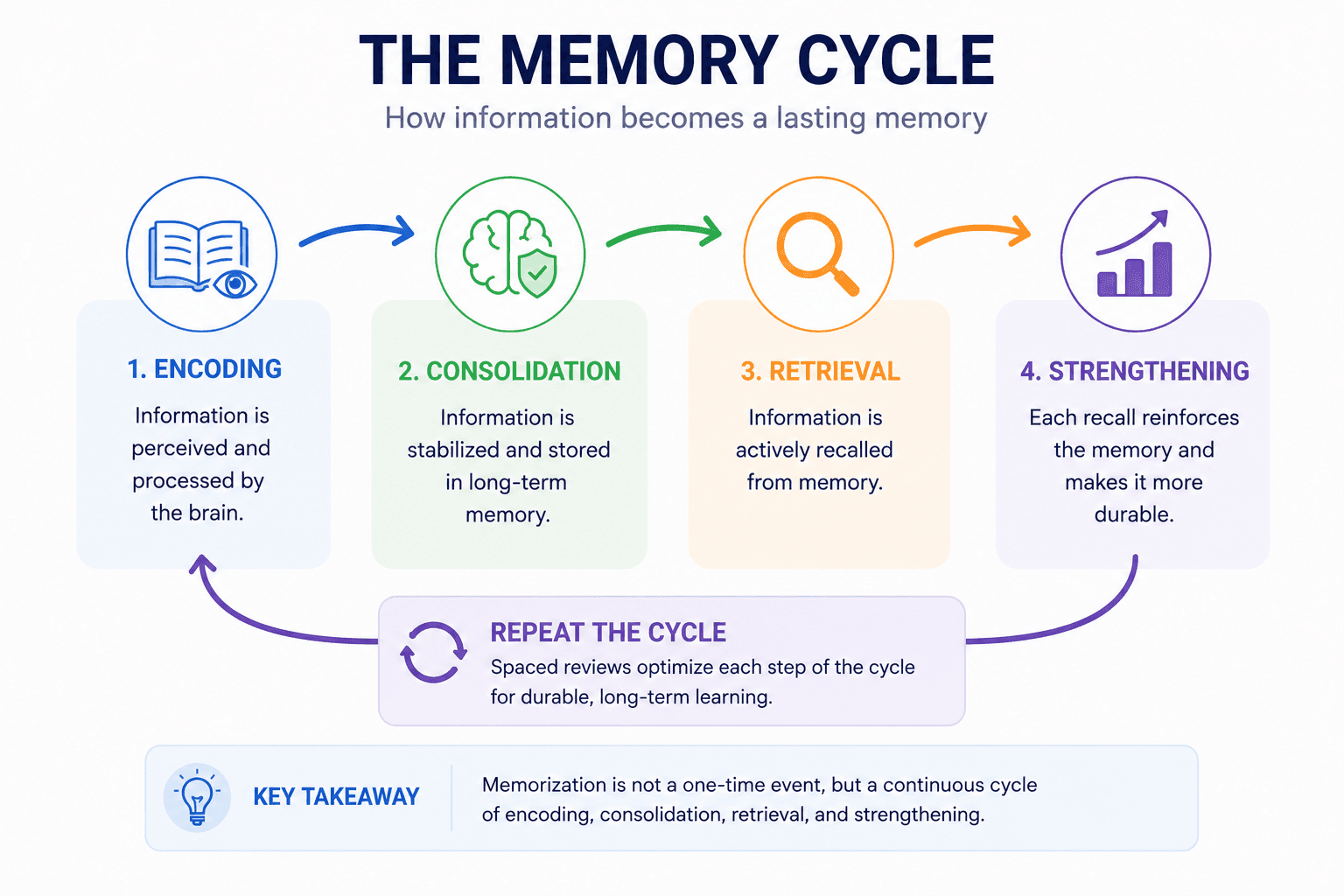
Memorization is not a one-time event. It is a continuous cycle where information is encoded, consolidated, retrieved, and strengthened through targeted review.
The problem is rarely intelligence itself. In most cases, memorization difficulties come from ineffective learning methods.
Rereading creates familiarity, but familiarity is not the same as recall. Reliable active recall builds stronger retrieval.
Cramming may help temporarily, but forgetting quickly returns after a few days. In most cases, spaced repetition is more durable.
After a certain duration, attention decreases and memory performance drops. Shorter sessions usually preserve better cognitive quality.
Without regular recall, memory traces become harder to retrieve. This is the exact dynamic shown by the forgetting curve.
The brain remembers better when it must produce an answer, solve a problem or reformulate an idea. These are core memorization techniques for long-term memory.
Some methods create an illusion of mastery without strengthening memory. The most effective techniques force the brain to actively retrieve information and space learning over time.
Avoid Passive rereading
It creates familiarity without checking whether the information can be retrieved.
Prefer Active recall
Testing yourself forces the brain to reconstruct information, which strengthens memory.
Avoid Cramming
It can help short-term performance, but forgetting returns quickly after the exam.
Prefer Spaced repetition
Reviewing at the right moment slows the forgetting curve and stabilizes long-term memory.
Avoid Excessive highlighting
Too much highlighting turns everything into important information and reduces retrieval effort.
Prefer Targeted flashcards
A good flashcard isolates one idea, question or misconception to master.
Avoid Long and rare study sessions
They create cognitive fatigue and lower attention.
Prefer Short regular sessions
Repeated 5–15 minute sessions often produce better retention.
Thematic cluster
Browse the hub to connect memory, spaced repetition, neuroscience, and practical learning methods.
🧠 Open the learning science hubDurable memorization depends first on the number of high-quality recalls. Understanding also accelerates consolidation because meaningful knowledge is easier to retrieve later. In practice, regular intervals usually matter more than very long isolated sessions.
1 to 3 spaced recalls may be enough.
Several weeks of active retrieval are often required.
Daily consistency usually produces better results than intensive sessions.
Reviews spread across multiple weeks strongly improve retention.
There is no universal duration: memory depends on prior knowledge, sleep, context and retrieval frequency.
Forgetting is usually fastest at the beginning, then the curve flattens. This is not a failure: it is exactly what good review timing can exploit.
Poorly processed information can already begin to fade if it is not connected to meaning or context.
A significant portion of information may be lost without active recall.
Without review, forgetting can become dominant, especially for new or abstract information.
Non-reactivated memories become harder to retrieve.
Knowledge strengthened through spaced repetition remains accessible much longer.
The right strategy is not to reread for longer, but to retrieve information at the right moment.
Memory decays quickly without reactivation. This is a normal system property, not a motivation flaw.
Once this is clear, learning becomes a retrieval-and-timing design problem.
Each successful reactivation pushes the curve upward and outward.
The target is the edge of forgetting: not too early, not too late.
Learning relies on multiple systems with different behaviors.
Sleep stabilizes and reorganizes what was learned while awake.
Evening study plus next-morning reactivation is a high-yield sequence.
Memory is dynamic: retrieval strengthens traces, inactivity weakens them.
Retrieval practice and distributed practice consistently rank among the most effective learning techniques.
Produce the answer before seeing it: this effort strengthens memory beyond passive review.
Spread reviews at increasing intervals; compared with cramming, retention is higher at similar effort.
Large evidence bases show gains in retention, transfer, and conceptual understanding.
Fluency while rereading is often overconfidence, not durable recall.
Recognition is easier than production and predicts less robust performance.
High evidence: active recall and spacing. Lower impact alone: highlighting and rereading.
Initial encoding depth strongly affects later retrieval ease.
Flashcards are strongest for declarative knowledge and less sufficient alone for procedural practice.
| Content type | Flashcard fit | Examples |
|---|---|---|
| Declarative facts | Excellent | Vocabulary, formulas, definitions |
| Linked concepts | Good if well designed | Cause/effect, process steps |
| Complex reasoning | Partial only | Essays, multi-step proofs |
| Procedural skills | Not enough alone | Surgery, instruments, sports |
Complementary methods can boost outcomes further.
Alternate topics within a session to improve discrimination and transfer.
Ask “why is this true?” to build stronger conceptual links.
Teach concepts in your own words to expose and close gaps quickly.
Small consistent adjustments create the largest long-term gains.
Most blockers are process design issues, not ability limitations.
Distributed short sessions often beat occasional long sessions.
Fixed routines outperform motivation-dependent systems.
Cap new cards at a sustainable pace to avoid review debt.
Precise prompts and short verifiable answers outperform broad cards.
Flashcards operationalize retrieval practice and spacing; outcomes depend on design quality and consistency.
Atomic card design keeps grading clear and feedback actionable.
SM-2 and FSRS adapt intervals from performance to optimize effort over time.
Recent medical-education studies report meaningful gains with spaced flashcard systems.
Flashcards work because questions force active retrieval rather than passive recognition. With spaced repetition, review timing is optimized so knowledge is reinforced before major decay, which improves long-term memory with less wasted effort.
Mistakes also support learning when corrected quickly, short sessions reduce cognitive fatigue, and immediate feedback improves consolidation quality over repeated cycles.
This is the principle Memia uses to optimize long-term memorization. Discover Memia.
The most reliable strategy combines active recall and spaced repetition. Active recall means producing an answer without looking at notes, which directly strengthens retrieval pathways in long-term memory. Spaced repetition then schedules reviews when memory is starting to weaken, instead of reviewing too early or too late. Together, these memorization techniques convert study time into real cognitive training. Compared with passive rereading, they usually produce stronger retention and better transfer because the brain repeatedly reconstructs knowledge rather than simply recognizing it on the page.
Yes. A large body of cognitive psychology research shows that spaced reviews generally improve medium- and long-term retention compared with massed practice. The benefit comes from timing, not from doing more total hours. Reviewing right before substantial forgetting helps reconsolidate memory more efficiently. Results vary with prior knowledge, sleep quality, and review quality, but the overall direction is robust across studies: distributed practice is consistently better for durable learning than cramming. In practice, this is why modern systems focus on review intervals instead of fixed revision blocks.
Early forgetting is a normal feature of memory, not a sign of low ability. After initial encoding, new information is still fragile and can fade rapidly if it is not reactivated. Without retrieval opportunities, memory traces lose accessibility, especially for abstract or unfamiliar material. This is why active recall, understanding, and repeated spaced retrieval make such a difference: they stabilize traces over time and improve access when needed. The forgetting curve describes this dynamic clearly, and good review timing uses it to protect long-term memory instead of fighting it blindly.
Flashcards are especially effective for declarative knowledge: vocabulary, definitions, formulas, key concepts, and cause-effect relations. They can also support complex topics when content is decomposed into clear questions. However, they are not enough by themselves for procedural performance, such as open-ended writing, case analysis, or advanced problem solving. The strongest approach is mixed practice: use flashcards for high-frequency retrieval, then apply knowledge in realistic tasks. That combination improves both memory strength and practical transfer, which is essential for meaningful long-term learning outcomes.
There is no universal timeline. Retention depends on prior knowledge, content complexity, sleep, stress, context, and how often information is actively retrieved. A simple concept can stabilize after a few spaced recalls, while complex skills may require weeks of retrieval and application. The strongest predictor is usually regular reactivation rather than one long study session. In other words, durable memory is built through repeated high-quality recalls over time. The goal is not maximum session length, but consistent retrieval at intervals that match your current memory strength.
Daily study is not an absolute rule, but frequent short sessions usually improve retention quality. Regular retrieval prevents large forgetting gaps and reduces cognitive overload compared with occasional marathon sessions. In practice, short routines make it easier to maintain attention and protect long-term memory. If daily practice is not possible, prioritize session quality: active recall beats passive rereading. A realistic, repeatable schedule with consistent retrieval is generally more effective than intense but irregular bursts, especially when preparing knowledge for future reuse.