≈ 40-50% forgotten after 1 hour
Memory decay starts very quickly after initial learning.
The Ebbinghaus forgetting curve shows that memory drops quickly after first exposure when memorization is not reinforced. The good news is that with well-timed review and spaced repetition, learning becomes more durable and information can be retained far longer with less effort.
The Ebbinghaus forgetting curve describes how quickly information disappears from memory without review.
Topics
Hermann Ebbinghaus (1850-1909) was the first psychologist to study memory experimentally and quantitatively. By using lists of meaningless syllables as learning material--to remove familiarity effects--he measured retention rates at different intervals after learning.
His results, published in 1885 in Über das Gedächtnis (On Memory), revealed two foundational findings still valid today: the forgetting curve and the spaced learning curve.
These numbers concern information learned once, with no review at all. They are striking--but they do not mean the situation is hopeless.
What makes Ebbinghaus's work remarkable is the rigour of his self-experimentation. He invented nonsense syllables (CVC combinations like "DAX" or "BOK") specifically to eliminate familiarity effects -- he wanted to study pure memory, stripped of meaning and prior association. Over years of experiments, he memorised thousands of these syllable lists, then measured how long it took to relearn them after different intervals.
The "savings score" was his key metric: if a list that originally took 10 minutes to memorise could be relearned in 6 minutes after a delay, the savings score was 40%. This indirect measurement of memory was methodologically elegant -- and his findings have been replicated and confirmed by subsequent generations of researchers using more varied materials.
The forgetting curve is a decreasing exponential curve: it drops steeply in the hours immediately following learning, then flattens progressively. This shape reflects a fundamental property of memory -- recently encoded traces are fragile and lose accessibility rapidly, while memories that survive the initial consolidation window become progressively more stable.
The practical implication is counterintuitive: the timing of the first review matters more than any subsequent review. A review at 24 hours has a dramatically larger impact on long-term retention than the same review at 72 hours. The curve does not wait -- it starts falling immediately after encoding stops.
This chart illustrates how quickly information is forgotten without review, and how spaced repetition improves long-term retention.
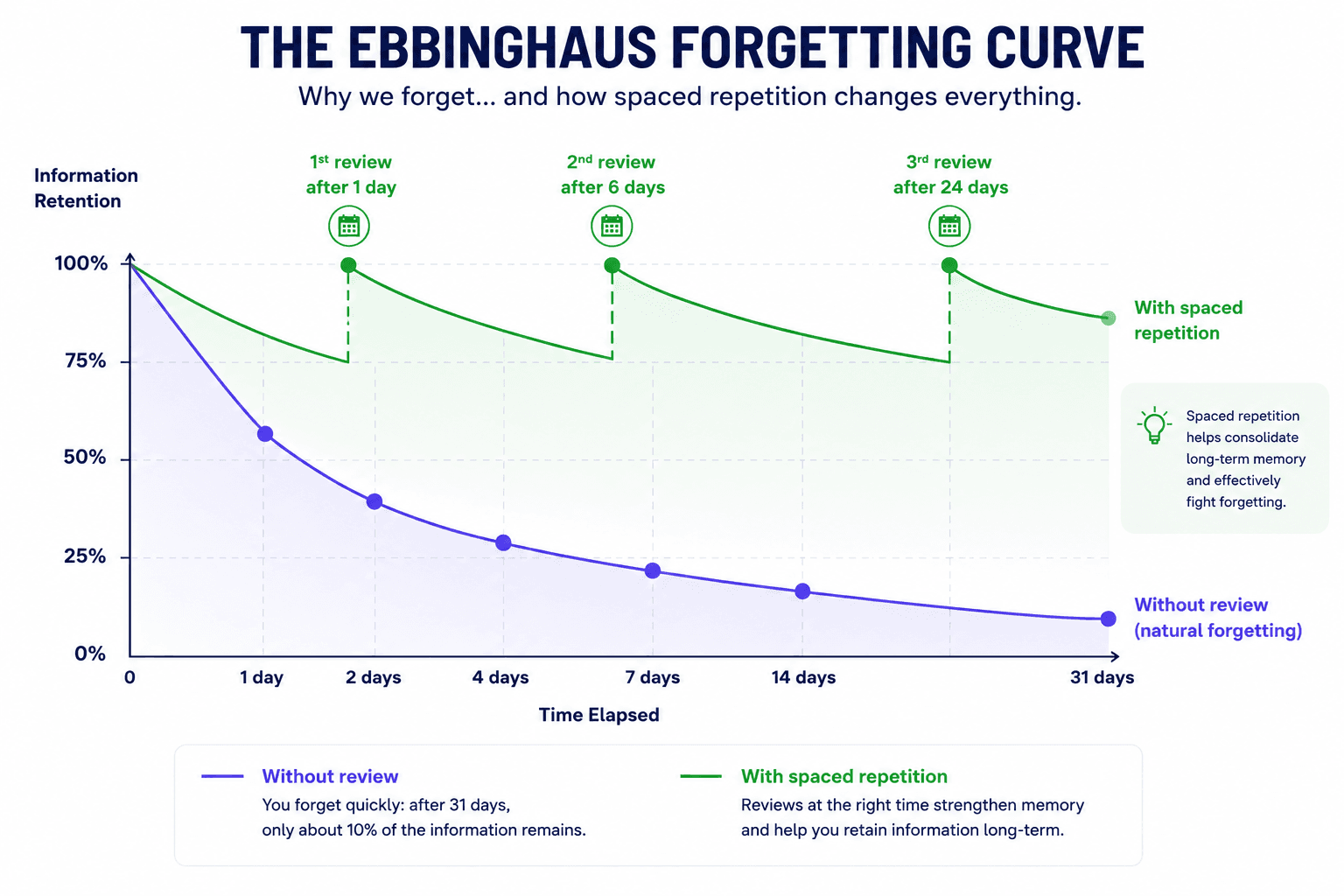
Research on memory retention shows that forgetting happens extremely quickly after initial learning, especially without active review.
≈ 40-50% forgotten after 1 hour
Memory decay starts very quickly after initial learning.
≈ 70% forgotten after 24 hours
Without review or retrieval practice, a large portion of newly learned information disappears within a day.
4 to 6 reviews are often enough
Research on spaced repetition suggests that a small number of well-timed reviews can strongly stabilize long-term memory.
10-30% better retention
Studies on the spacing effect consistently show better retention compared to cramming.
Sources: Ebbinghaus (1885), Cepeda et al. (2006), Murre & Dros (2015).
This simplified table illustrates how memory retention evolves depending on whether information is reviewed or not.
| Time elapsed | Without review | With spaced repetition |
|---|---|---|
| 1 hour | ≈ 50-60% retained | ≈ 90-100% retained after rapid reinforcement |
| 24 hours | ≈ 30% retained | ≈ 80-95% retained |
| 7 days | ≈ 20-25% retained | ≈ 75-90% retained |
| 31 days | ≈ 10-15% retained | ≈ 70-85% retained |
These values are simplified educational estimates based on Ebbinghaus's work and modern spaced repetition research. Actual retention varies depending on the type of learning and review quality.
Ebbinghaus obtained exact percentages with artificial material (nonsense syllables). With meaningful content--courses, vocabulary, concepts--the curve is less steep because meaning supports encoding and associations. The overall shape stays valid, but percentages are usually less severe in real learning contexts.
The Ebbinghaus forgetting curve explains why information disappears quickly after learning: early memory traces are fragile until they are reactivated.
The drop is especially fast in the first hours after learning. This is linked to short-term memory dynamics: recently encoded information is temporarily stored in the hippocampus. Without consolidation--mainly happening during sleep--it starts degrading quickly.
Without review, newly learned information can disappear within days. As time passes, the curve flattens: memories that survive the first hours are relatively more stable.
So "why we forget" is less about lack of intelligence and more about normal memory dynamics when retrieval is not repeated.
Later research introduced the concept of memory strength: strongly consolidated information resists forgetting better and requires much longer review intervals before the next review becomes necessary. Poorly consolidated information -- encoded shallowly, without sleep, without review -- decays rapidly and returns to near-zero very quickly.
This concept underlies modern spaced-repetition algorithms: rather than applying a fixed review schedule to everyone, they estimate each individual memory's current strength and schedule the next review to occur precisely when that strength is about to drop below a threshold. The stronger the memory, the longer the interval; the weaker, the sooner it needs reinforcement.
The Ebbinghaus model describes forgetting as passive temporal decay -- memories simply fade over time without use. But subsequent research revealed a second, often more significant mechanism: interference. Interference occurs when similar memories compete with each other, weakening retrieval of both.
Proactive interference is when older knowledge disrupts the encoding of new material (prior French vocabulary making it harder to learn Spanish). Retroactive interference is the reverse: new learning overwrites or blurs older memories (studying Spanish right after French degrades the French you just encoded). In practice, both types are frequent -- which is why alternating unrelated topics is a better study strategy than massing sessions on similar content.
spaced review timing is considered one of the most effective methods to fight forgetting because it schedules review when memory starts to weaken.
Ebbinghaus's most useful finding is not the forgetting curve itself, but what he observed about review effects. Each time you review, several things happen.
This is the core mechanism of spaced review timing: exploit forgetting-curve dynamics to maximize retention with minimal reviews.
Reviewing too early (while retention is still very high) is inefficient: the memory is already strong, so the added gain is small. Reviewing too late (after memory collapse) forces near-relearning from scratch. The optimal interval is when retention starts dropping meaningfully--typically around 70% to 90% retention depending on the study.
Long-term memory requires repeated retrieval and reinforcement. Without recall opportunities, knowledge feels familiar but fades quickly over time. Ebbinghaus's work provided the empirical foundation that allowed later researchers and engineers to build practical systems around the Ebbinghaus forgetting curve -- automating the optimal timing of every review.
To see the underlying mechanism in detail, read spaced repetition.
For the broader cognitive model, review how memory works.
In the late 1980s, Piotr Wozniak developed the SM-2 algorithm for his SuperMemo software -- the first system to translate the Ebbinghaus curve into a practical, automated review schedule. The insight was simple but powerful: instead of reviewing on a fixed calendar, schedule each item individually based on how well it was recalled last time. Items recalled easily get longer intervals; items recalled with difficulty get shorter ones.
SM-2 assigned each card an "ease factor" that adjusted based on user-rated difficulty, then computed the next review interval using a formula derived from experimental retention data. This algorithm remains the foundation of Anki -- still the most widely used flashcard application in the world -- and has been used by millions of learners across four decades.
SM-2, despite its effectiveness, had known limitations: its interval calculations did not adapt to the actual shape of each learner's personal forgetting curve, and it could drift significantly from optimal over long time horizons. FSRS (Free Spaced Repetition Scheduler) was developed to address these gaps. Rather than using fixed formulas, FSRS uses a two-component model of memory -- stability and retrievability -- and refines its parameters through large-scale analysis of real review data.
Stability represents how long a memory can be retained before dropping below a target retention threshold. Retrievability represents the current probability of successful recall given elapsed time since the last review. FSRS optimises interval predictions by fitting these parameters to each learner's actual recall history -- meaning it gets more accurate the more you use it. Studies comparing FSRS to SM-2 show substantially better interval precision and higher long-term retention for equivalent total review time.
Benchmarks comparing FSRS to SM-2 on large real-world datasets show that FSRS predicts recall probability significantly more accurately than SM-2, particularly over long intervals (30+ days). The practical result: fewer unnecessary early reviews and fewer missed reviews -- better retention with less total time spent per card.
Ye et al. (2024), A Stochastic Shortest Path Algorithm for Optimizing Spaced Repetition, ACM KDDIf your goal is to remember information longer, combine active retrieval with progressive spacing instead of passive rereading.
Understanding the forgetting curve changes three behaviors in practice.
In practical terms, strengthen every session with active recall before checking your notes.
For a complete framework, follow these effective learning methods.
The first review should happen quickly--ideally within 24 hours, and certainly before the end of the week. This is where the curve drops fastest, so review has the greatest relative impact. A quick evening pass over notes can cut information loss dramatically.
Cramming creates short-term fluency but very weak retention after 48 hours. Content reviewed all at once the night before follows the forgetting curve from the next day--with a rapid, predictable drop.
A partially forgotten memory reactivated just before disappearing consolidates more strongly than one reviewed while still very fresh. Partial forgetting is a condition for durable memorization, not an obstacle.
A Cepeda et al. (2009) study analyzed optimal intervals across thousands of question-answer pairs and confirmed that spacing should grow exponentially with successful repetitions. Their model predicts that after one learning event, the ideal delay before first review is one to two days--not a few hours, not a week.
Cepeda et al. (2009), Optimizing Distributed Practice, Experimental PsychologyTake an exam-preparation scenario: learning 30 vocabulary words in a foreign language. On Day 0, you complete initial learning with examples and a quick self-check.
Within 24 hours, rapid forgetting appears: some words already feel uncertain without retrieval practice. You then schedule spaced reviews on Day 1, Day 3, Day 7, and Day 21.
Each review stays short but active: recall first, correct immediately, then retrieve again. This is a practical way to study effectively while reducing total revision time.
The result is better learning retention: instead of cramming and relearning, you progressively consolidate knowledge into long-term memory.
Some study habits feel productive in the moment but significantly reduce long-term retention. Understanding which habits work against memory consolidation -- and why -- is the first step to avoiding them.
Rereading notes or textbooks creates a feeling of familiarity -- but familiarity is not the same as retrievability. When you reread, you are processing information with external support (the page is right there). When you test yourself, you force your brain to retrieve from memory with no cues. That retrieval effort is what strengthens the memory trace.
The practical difference is significant. Karpicke & Roediger (2008) showed that students who studied a text once then tested themselves repeatedly retained nearly 50% more after a week compared with students who restudied the text four times. Replace rereading sessions with self-quizzing: cover your notes, try to recall, then check. The struggle is the point.
Cramming works: you can pass an exam this way. What cramming cannot do is move information into long-term memory. Because it compresses all review into a single massed session, it captures none of the spacing benefit that makes memories durable. The forgetting curve begins dropping from the moment you stop reviewing -- and after a single cramming session, the drop is steep.
Students who cram also tend to suffer from interference: because so much is encoded in a short window without proper consolidation, similar items blur together. The alternative is to spread review across multiple sessions over days or weeks -- even three spaced sessions total outperform five massed sessions in long-term retention.
Memory consolidation is not a passive process that happens automatically during waking hours. It is actively driven by sleep -- particularly slow-wave sleep, during which the hippocampus replays newly encoded memories and transfers them to cortical long-term storage. Learning a complex topic and then staying up late, or sleeping fewer than 6 hours, can undo a significant portion of the day's encoding.
The practical implication: if you have an important learning session in the evening, prioritise sleep that night rather than squeezing in more review. A well-slept brain consolidates more effectively than an exhausted one reviewing for an extra hour.
The original curve is based on a very specific setup: Ebbinghaus largely experimented on himself and used nonsense syllables. This gave clean measurements, but it does not represent the full variety of real-world learning.
So the exact percentages should not be applied mechanically to every context. Learning meaningful concepts, solving problems, or studying connected material engages additional mechanisms compared with memorizing arbitrary lists. The curve's shape is valid; the numbers are approximate.
Forgetting speed also depends on attention during encoding, prior knowledge, meaning, sleep quality, and usage context. Individual differences matter too: some learners have naturally faster or slower forgetting rates, and FSRS-style algorithms can detect and adapt to these differences over time.
In short, the forgetting curve is a high-value educational model for effective studying -- not a strict law that predicts every learner in every context.
Murre & Dros (2015) replicated Ebbinghaus's original experiment using the same nonsense-syllable methodology and confirmed the core exponential shape of the forgetting curve. However, they also showed that individual differences in forgetting rate were substantial -- the curve captures population averages, not individual trajectories. This is one of the key motivations behind personalised SRS algorithms that track individual retention rates rather than applying universal intervals.
Murre & Dros (2015), Replication and Analysis of Ebbinghaus's Forgetting Curve, PLOS ONEIt applies to declarative learning--facts, vocabulary, concepts, dates. The slope varies with meaning, attention during encoding, and associations. For procedural learning (motor skills, automatisms), forgetting is usually less steep--skills resist time better.
Yes. That is exactly what spaced repetition does over time. With enough well-spaced reviews, intervals can stretch to months or even years. Some highly consolidated memories seem to resist forgetting indefinitely, though the notion of truly permanent memory remains debated.
It depends on complexity and spacing quality. In many cases, 4 to 6 well-spaced reviews are enough to stabilize memory for months. With an SRS algorithm, this happens naturally without manually calculating intervals.
There is no single timeline. Without review, forgetting is often steep in the first 24 hours and then slows down. The exact pace depends on meaning, attention during learning, prior knowledge, and whether the information is actively reused.
The most reliable approach combines active recall and spaced repetition. In practice, test yourself, correct mistakes immediately, and increase intervals progressively. This aligns with forgetting-curve dynamics and maximizes long-term retention.
No. The curve's exponential shape is consistent, but the rate of forgetting varies considerably between individuals and between types of material. Some people forget faster than others; meaningful, emotionally salient, or frequently used information is retained longer. Adaptive SRS algorithms like FSRS account for these differences by learning each user's personal retention patterns over time.
Memory stability is a value used in modern SRS algorithms (particularly FSRS) to represent how long a memory can be retained before it drops below a target recall probability -- typically 90%. After each successful review, stability increases, which allows the next interval to be longer. After a failed recall, stability resets to a lower value. This two-component model (stability + retrievability) is more accurate than older single-factor approaches like SM-2.
Explore the cluster
Use the hub to navigate memory, spaced repetition, neuroscience, and practical learning strategies.
📘 Open the learning science hubThis article relies on established scientific work in cognitive psychology and memory science to explain forgetting mechanisms and spaced-repetition principles.
Hermann Ebbinghaus — Über das Gedächtnis (1885)
Foundational publication that introduced one of the first experimental measurements of forgetting over time.
Cepeda et al. — Optimizing Distributed Practice in Verbal Recall Tasks (2009)
Experimental study refining optimal review spacing to improve long-term verbal retention.
Piotr Wozniak — SuperMemo and the SM-2 Algorithm
Historical reference on formal spaced-repetition scheduling in modern learning software.
FSRS team — Open Spaced Repetition (FSRS)
Research and documentation around FSRS, a modern spaced repetition algorithm designed to optimize review scheduling and long-term retention.
Alan Baddeley, Michael W. Eysenck & Michael C. Anderson — Memory (2020)
Reference psychology textbook synthesizing major contemporary models of human memory.
Ebbinghaus's findings still sit at the core of modern spaced-repetition systems used in learning applications.